
Critical cluster edited by Adam Mahler and Jean Dangler for La corónica
- Submit abstract proposal of 300 words by 1 February 2025 and final essays by 15 June 2025.
- Contact: Adam Mahler (am*****@*******rd.edu) and Jean Dangler (jd******@****ne.edu).
- See Call for Papers below:
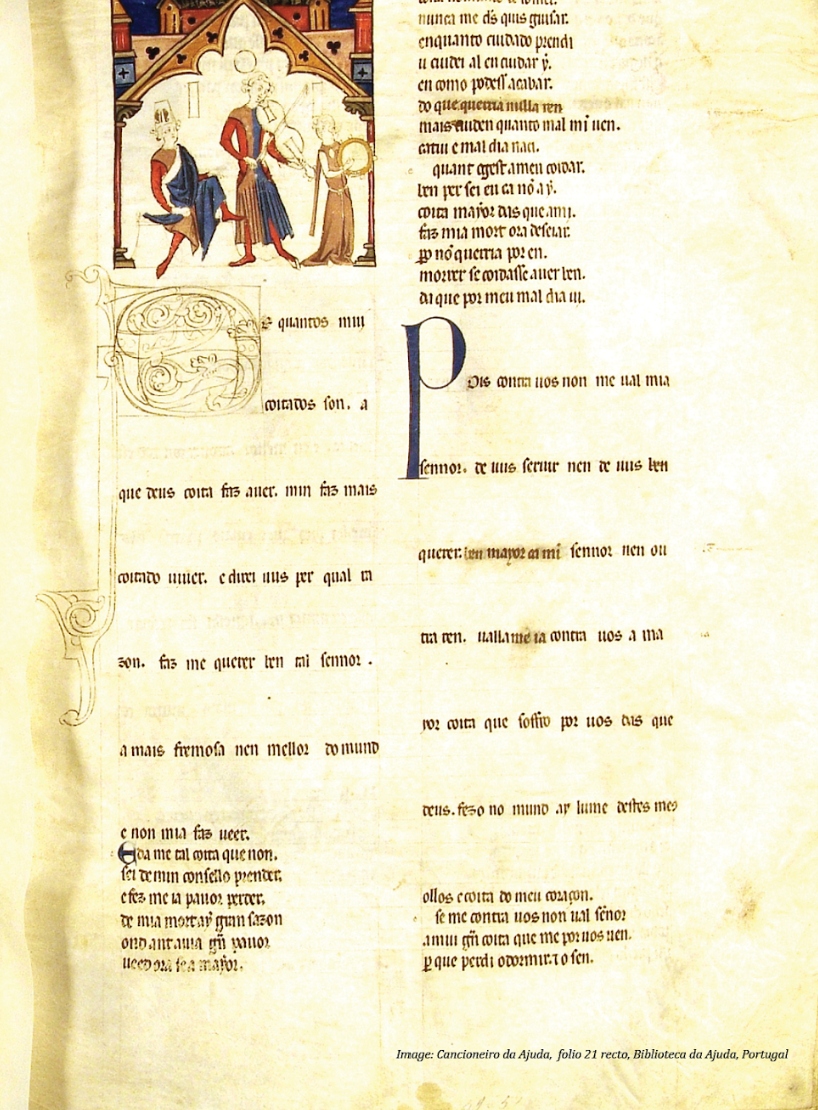 The late nineties and early aughts saw a flurry of scholarship characterized by a newfound openness to the marginalized voices of the medieval Iberian literary tradition, especially its lyrical poetry. Collections like Josiah Blackmore and Gregory Hutcheson’s Queer Iberia (1999) and essays like José Piedra’s “The Black Stud’s Spanish Birth” (1993) asserted the literary authority of the minoritized lyrical subject, forever changing the contours of our field. More recent work by scholars such as Nicholas R. Jones (Staging Habla de negros, 2019; Cervantine Blackness, 2024) and Sarah Ifft Decker (Fruit of Her Hands, 2022) have given Hispanists much-needed intellectual latitude by upholding majority-voiced impersonations of minoritized voices and the Peninsula’s vast legal archives, respectively, as loci of genuine insight into non-modern subject formation. Diverse critical interventions in this vein share a willingness to speculate, or—to use Saidiya Hartman’s term—a willingness to engage in critical fabulation: an informed extrapolation from the archives to rectify the lacunae present in those very literary records.
This special issue of La corónica embraces and expands on the speculative with an eye towards the lyrical poetry produced in medieval Iberia between the eleventh and fifteenth centuries. Considered jointly with other medieval Iberian lyrical outputs in various languages, the cancione[i]ros and cançoners constitute sprawling inventories of lyrical expression across ever-blurring lines of gender, ethnorace, religion, class, species and even categories of animacy. It is of the utmost importance to examine these intersections in an age of climate catastrophe and political as well as social discord that imperil the academic enterprise and humanistic inquiry writ large.
Facing up to the cruxes of representation in the longue durée, the issue asks and searches for answers to questions such as: What do post-convivencia readings of Hispano-Semitic Andalusi lyrical poetry—as well as the Romance forms it influenced—have to offer us in our understanding of pluralistic community? What was the medieval intellectual posture toward the non-human as revealed in Iberian lyric? How do medieval poetic representations of ethnicity and race ground elements of Ibero-American racialized capitalism? How might we continue to question the gender fluidity of the Galician-Portuguese cantigas and the muwashshahat? How can we incorporate legal and historical documents into our literary analysis without reproducing the social prejudices embedded within those very statutes? We also welcome contributions that reassess the impact of earlier interventions on behalf of the speculative in literary criticism on medieval Iberia, as well as the fierce blowback they confronted.
In short, through our roster of contributions, we aim to speculate fabulously, to reflect productively, and to theorize around the social realities affirmed and subverted, flaunted and buried, in the medieval Iberian lyrical tradition.